
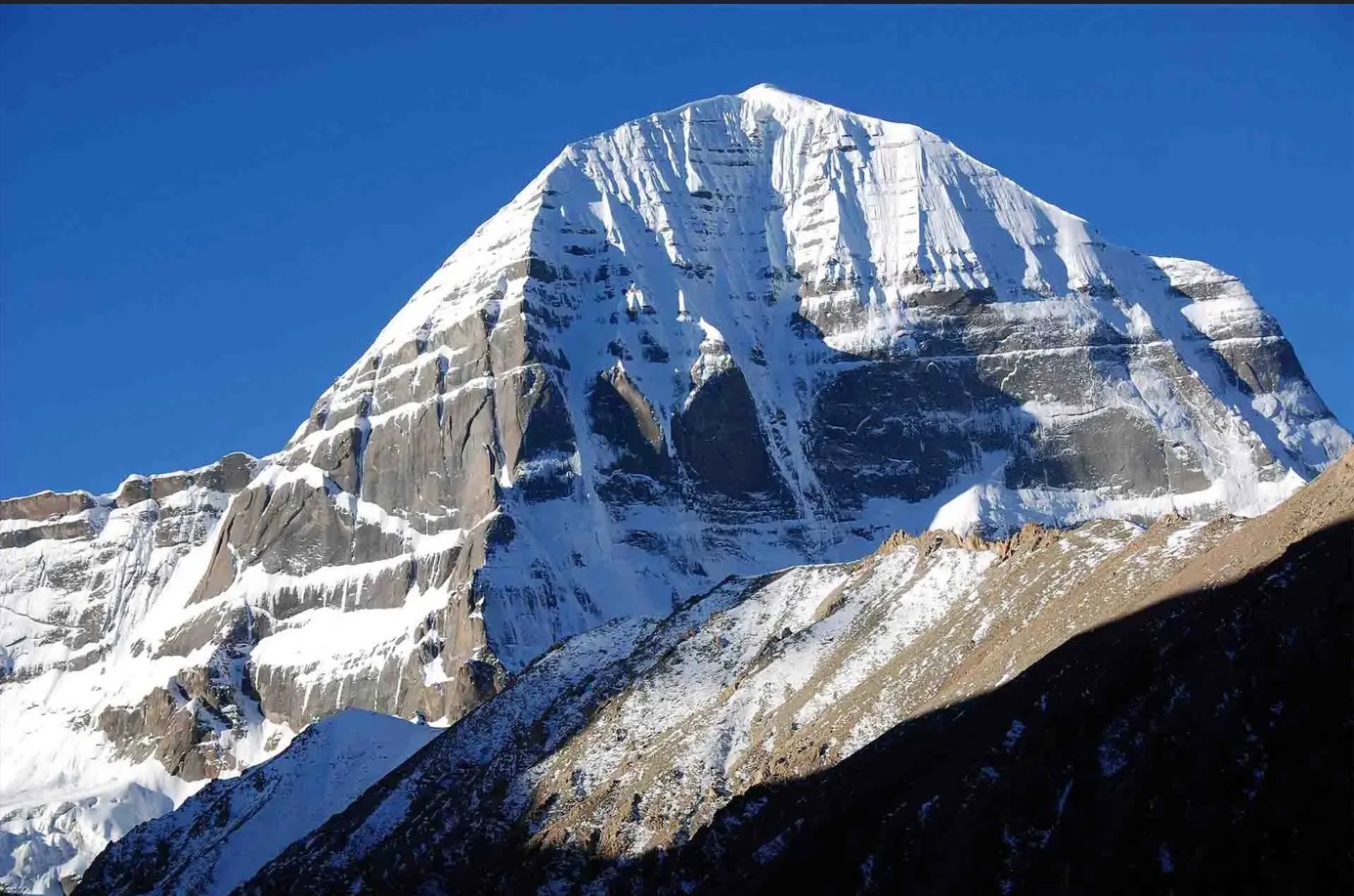
Mount Kailash is a 6,638-meter peak in western Tibet that four separate religious traditions regard as sacred: Hinduism, Tibetan Buddhism, Jainism, and Bon. Hindus consider it the home of Shiva, Tibetan Buddhists the residence of the deity Demchok, Jains the site where the first Tirthankara reached liberation, and Bon followers the dwelling of a sky goddess. No expedition has ever summited it.
Four religious traditions look at the same mountain in western Tibet and see four different homes of the divine. Hindus see the seat of Shiva. Tibetan Buddhists see the residence of Demchok. Jains see the place where their first Tirthankara found liberation. Followers of Bon, the older religion of the Tibetan plateau, see the dwelling of a sky goddess and the spiritual center of a kingdom that no longer exists. None of these traditions borrowed the idea from another. Each arrived at Kailash independently, and each still sends pilgrims there today.
This is an attempt to explain, respectfully and as accurately as the available sources allow, what each tradition believes about the mountain, why the lake beside it matters just as much, and what the physical act of walking around Kailash is meant to accomplish.
A mountain no one has climbed
Start with a fact that says something about how seriously this reverence is taken: Mount Kailash, at 6,638 meters, has never been summited. No expedition has a verified successful ascent. Climbing is prohibited by the Chinese government specifically because of the mountain’s religious status, and even without that prohibition, most climbers who have looked at the peak have chosen not to attempt it out of respect for what it represents to the people who worship it.
There is a story, repeated across Buddhist and Bon sources, that the Tibetan saint Milarepa reached the summit centuries ago, not by climbing but by riding the rays of the rising sun, after winning a magical contest against a Bon practitioner named Naro Bonchung. Whether or not you take that story as literal history, it captures something true about how the mountain is regarded: reaching the top is not the point, and treating it as a mountaineering objective misses what pilgrims are actually there to do.
Shiva’s mountain: Kailash in Hinduism
In Hindu tradition, Kailash is the home of Shiva, one of the principal deities, along with his consort Parvati and their children. Hindu texts also identify the mountain with Mount Meru, the cosmic mountain described as the axis of the universe in South Asian religious thought. Nearby, the mountain is associated with the origin of the Ganges, the river said to have descended from the heavens and been tamed in Shiva’s hair before reaching the plains.
For Hindu pilgrims, visiting Kailash and Manasarovar together is understood as a journey to the literal source of divine order, not a metaphorical one. The lake itself carries its own story: according to the tradition, Brahma created it from his mind, which is where the name Manasarovar, the lake of the mind or consciousness, comes from.
The seat of Demchok: Kailash in Tibetan Buddhism
Tibetan Buddhism identifies Kailash with Mount Meru as well, placing it at the center of its own cosmological map. More specifically, tantric Buddhist tradition holds that the mountain is the residence of Demchok, also known as Chakrasamvara, a buddha associated with supreme bliss, along with his consort Vajravarahi. Kailash is counted among Tibet’s Three Holy Places and is identified as one of the twenty-four sacred sites, or pithas, recognized across the wider tantric Buddhist world, under the name Himavat.
Buddhist accounts also describe the mountain as having been blessed directly by the historical Buddha and five hundred arhats, and later by the tantric master Padmasambhava, who is credited with helping establish Buddhism in Tibet. The Drigung Kagyu lineage in particular built a strong association with the site, with its founder said to have sent large numbers of practitioners there for meditation retreat.
In this tradition, Lake Manasarovar carries a matching symbolism: if Kailash represents the father, the lake represents the mother, and the two together are understood as a complete cosmic pairing rather than two separate holy places that happen to sit near each other.
Where a Tirthankara found liberation: Kailash in Jainism
Jain tradition holds that Rishabhanatha (also called Rishabhadeva), the first of the twenty-four Tirthankaras, the enlightened teachers of Jainism, attained moksha, or liberation from the cycle of rebirth, at Kailash. Some Jain sources refer to the peak by a separate name, Ashtapada, in connection with this event. For Jain pilgrims, the mountain is not one holy site among several but the specific location tied to the very first Tirthankara’s final liberation, which gives it a foundational place in Jain sacred geography.
Bon: the mountain that came first
Bon is the indigenous religious tradition of the Tibetan plateau, predating the arrival of Buddhism, and for Bon followers Kailash is not a borrowed holy site but the original one. The mountain is described as the home of a sky goddess named Sipaimen, and it served as the spiritual and cultural center of Zhang Zhung, the ancient kingdom that once occupied this part of the plateau before it was absorbed into the Tibetan empire.
One detail sets Bon pilgrims apart from the other three traditions in practice: while Hindus, Buddhists, and Jains circumambulate Kailash clockwise, Bon pilgrims walk the kora counterclockwise. It is a small physical difference, but it reflects a real doctrinal one: Bon has its own distinct ritual logic, separate from Buddhist practice rather than a mirror of it.
Kailash across four traditions at a glance
| Tradition | How Kailash is regarded | Central figure |
|---|---|---|
| Hinduism | Home of Shiva, identified with the cosmic Mount Meru | Shiva and Parvati |
| Tibetan Buddhism | Residence of the tantric deity Demchok, one of 24 sacred pithas | Demchok (Chakrasamvara) |
| Jainism | Site where the first Tirthankara reached liberation, also called Ashtapada | Rishabhanatha |
| Bon | Home of the sky goddess Sipaimen, spiritual center of the former kingdom of Zhang Zhung | Sipaimen |
Each tradition reached its view of the mountain on its own, and none of the four accounts overlaps with another.
Lake Manasarovar: the lake beside the mountain
Lake Manasarovar sits at roughly 4,600 meters, making it one of the highest freshwater lakes in Asia, spanning around 320 square kilometers with a maximum depth of about 100 meters. It is not an afterthought to the Kailash pilgrimage. For many pilgrims, ritual bathing in its waters, believed across Hindu tradition to cleanse sin and purify the soul, is as central to the journey as the walk around the mountain itself. In Buddhist tradition, the lake is where Buddha’s mother Maya is said to have bathed for purification before his conception, reinforcing the lake’s association with birth and renewal rather than only with cleansing.
The lake and the mountain are treated as a single sacred unit by every tradition involved. Pilgrims do not choose one over the other. They visit both, in a fixed order, as parts of the same act of devotion.
The kora: walking around a sacred mountain
The central ritual of the Kailash pilgrimage is the kora, a circumambulation of the mountain along a path roughly 52 to 53 kilometers long. Most pilgrims complete it over three days, walking from Darchen or Yamadwar to the monastery at Dirapuk on the first day, crossing the route’s highest point, Dolma La pass, at around 5,630 meters, on the second day before descending to Zuthulpuk, and finishing the final stretch back to the starting point on the third.
The act of circling a sacred object rather than approaching or entering it is common across several of these traditions, but the meaning attached to completing a Kailash kora is unusually strong. Popular belief among some Hindu and Buddhist pilgrims holds that a single circuit of the mountain helps cleanse the sins of one lifetime, though how literally any individual pilgrim takes that claim varies. What is consistent is the sense that the kora is not a scenic walk but a deliberate spiritual undertaking, done with intention, often in near silence, and frequently by pilgrims who have traveled a considerable distance and gone through a lengthy permit process for the chance to do it.
What pilgrims say the journey means
Ask people who have completed the kora why they came, and the answers vary by tradition but rarely by intensity. Hindu pilgrims often describe it as the closest they will come in this life to standing at Shiva’s own home. Buddhist pilgrims frequently frame it as an act of merit that benefits themselves, their families, and their future rebirths. Jain pilgrims come carrying the specific weight of Rishabhanatha’s liberation on that exact ground. Bon pilgrims come to a place their tradition never had to import from anywhere else.
What unites all of them is something simpler than doctrine: a willingness to travel to one of the most remote inhabited plateaus on earth, endure several days of thin air and hard walking, and do it not for the view from the top, since no one is allowed to reach it, but for what circling the base is understood to mean. That distinction, between climbing a mountain and honoring one, is close to the center of why Kailash still draws pilgrims from four different faiths after so many centuries.
A shared site, not a shared religion
It is worth being precise about what “sacred to four religions” actually means here, because it is easy to flatten into something vaguer than it is. These traditions do not share a single belief about Kailash. They share a location. Hinduism, Tibetan Buddhism, Jainism, and Bon each bring their own cosmology, their own deity or figure, and their own reason for the mountain’s importance, and those reasons do not overlap or merge into one another. A Hindu pilgrim circling Kailash is not thinking about Demchok, and a Bon pilgrim walking the opposite direction is not thinking about Rishabhanatha’s liberation. What they have in common is proximity: four unrelated religious systems each independently settled on the same remote peak as central to their understanding of the sacred.
That is, if anything, a stranger and more interesting fact than a single shared myth would be. It means Kailash was not claimed by one tradition and adopted by others afterward. Each looked at the same remote terrain and arrived, on its own terms, at the conclusion that this was a place where the divine could be found.
Frequently asked questions
1. Has anyone ever climbed Mount Kailash?
No verified ascent exists. The Chinese government prohibits climbing the mountain because of its religious significance, and the ban is widely respected by mountaineers as well as enforced by law.
2. Why do Hindus, Buddhists, Jains, and Bon followers all consider the same mountain sacred?
Each tradition developed its association with Kailash independently rather than adopting it from another. Hindus regard it as Shiva’s home, Buddhists as the residence of the deity Demchok, Jains as the site of Rishabhanatha’s liberation, and Bon followers as the home of a sky goddess central to their older tradition.
3. What is the kora and how long does it take?
The kora is a circumambulation of Mount Kailash along a path of roughly 52 to 53 kilometers, most commonly completed on foot over three days, crossing the route’s high point at Dolma La pass, around 5,630 meters.
4. Why do Bon pilgrims walk the kora in the opposite direction from everyone else?
Bon ritual practice runs counterclockwise as a matter of doctrine, distinct from the clockwise circumambulation followed by Hindu, Buddhist, and Jain pilgrims. It reflects Bon’s own independent ritual tradition rather than a variation on Buddhist practice.
5. Is Lake Manasarovar considered as sacred as the mountain itself?
Yes. Pilgrims from these traditions treat the lake and the mountain as a linked pair rather than separate stops, with ritual bathing in the lake regarded as central to the pilgrimage in its own right.
6. Do you need to belong to one of these religions to visit Kailash?
No. Many travelers visit for the history, geography, and culture of the region without practicing any of the four traditions, though visiting with an awareness of what the site means to pilgrims makes for a more respectful trip.